
County Building "Homes" for Homeless

I don't care for zoos and rarely took my children to them when they were growing up. They seem so—to put it bluntly—cruel.
You look at these beautiful animals penned up in caged environments. Animals that were created to roam and hunt and exist in the wild freely, not locked up in an animal ecosystem. It feels so wrong to me.
In a recent County Communications Office article titled "County Starts Construction on Troy Street Sleeping Cabins", Cassie Sauders describes a sleeping cabin project getting underway on Troy Street in Lemon Grove.
Ms. Sauders writes that onsite features will include:
60 Sleeping Cabins
Communal areas for meals and gathering
A pet area
Hygiene facilities
Laundry
Case management services
Permanent housing navigation
Behavioral health assessments
Additional supportive services
The word "cabin" adds charm to the project when in reality they are nothing more than sheds. I'm assuming that "hygiene facilities" is just another word for bathrooms. How many of these are provided for sixty units, some possibly containing more than one resident?
"From 2007 to 2023, California's homeless population grew more than any other state's. Based on 2024 data, California has the highest total number of people experiencing homelessness in the U.S., with over 187,000 individuals. California accounts for over 24% of the nation's total homeless population."—Google
The last four items are just big ideas with no value. Case management, behavioral health assessments, housing navigation, and additional supportive services (so vague) don't mean a thing and rarely have helped our homeless population. Unless the case workers agree to live among the homeless, little evolution will ever come to fruition.
"Homelessness in California is a continuing and growing crisis. Individuals and families experiencing homelessness are without permanent housing largely due to a lack of affordable housing. Homelessness is often compounded by a lack of job training and supportive services to treat mental illness, substance abuse, or domestic violence."—California Department of Housing and Community Development
The California government has been throwing billions of dollars at this crisis with no recordable result data. There is not even solid proof that the homeless communities received these funds.

Here's the image associated with the article.
The very first thing that I noticed was the fence. Is the purpose of the fence to keep the homeless contained or to keep the community away? The cabins are called "sleeping cabins". What are the residents doing in the other 16+ hours?
The next thing that caught my attention is there is no nature inside the facility . . . no trees to sit under, no grass to feel under their feet, no birds singing. All nature appears to be located outside the fence. How do you heal people existing within a sensory deprivation container?
A lot of open space is wasted on the paved, driving area. There appear to be 11 or 12 parking spaces for 60 units. Do the residents not have cars or are not allowed to bring their cars? Some homeless live in their automobiles. The facility appears to be surrounded by roadways so there is no outside parking. And there would be a lot of road noise in the fenced area with no landscaping for blocking vehicle sounds. It is bordered by the SR-123, Troy Street and Sweetwater Road . . . all busy streets to cross on foot.
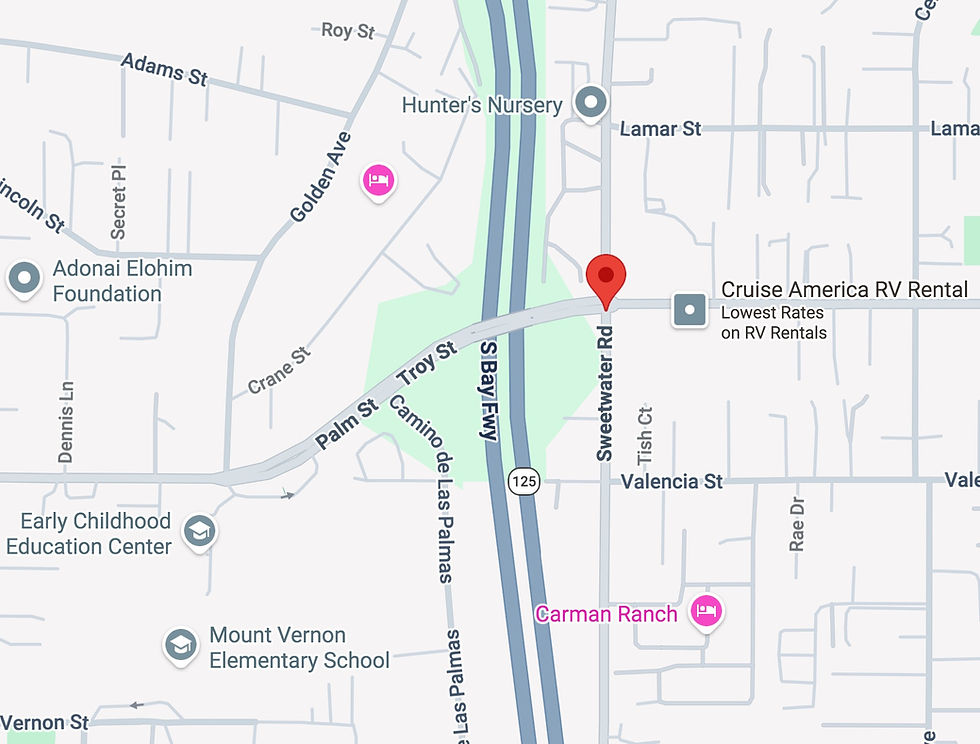
The videos (at the bottom of this article) say that there is 24/7 security. How will the residents get food? Will it be brought in or will they have to walk to a store? I don't see any nearby grocery stores. There is only a Cali BBQ, El Puerto Taco Shop and a Charley's Famous Hamburgers. The two elementary schools and early childhood education center are much closer. I bet that made the parents happy.
The little sheds all appear to be built on hardscape. It reminds me of those awful retention prisons you saw on the news during the lockdown. I can't tell for sure but it looks like the hardscape has gutters in it, like they plan to spray it down.
Do the individual units have windows or a locking door? I see little boxes on them, do they have air conditioners/heaters? Are the units made of wood or metal? Metal could get really hot in the summer and cold in the winter.
The dwellings with the blue roofs might be the "Communal areas for meals and gathering". The designer is assuming that all these people will be friends and get along. As in any society, that isn't always the case. And there aren't many private areas to get away when you "need some space". Maybe they could hang out in the pet area. Will the pets be living inside or outside the units?
These are proposed as a temporary residence. Define temporary—two months, two years, two decades?
This does not feel like a community for people down on their luck. It resembles a human zoo, locked in and being constantly watched.
The County would do better by purchasing a large ranch somewhere, away from busy roads. People could live in the updated barns. Rescue horses and dogs could be brought in with residents being responsible for the animals. Let them be loved by a horse, donkey, goat, dog, cat, chicken . . .whatever needs rescuing and taken care of. It becomes a symbiotic mutualism relationship. The homeless could learn new skills associated with ranch life and use those skills to enter the workforce. They could walk around in nature and become whole again. They could feel human.


Comments